ServicesStair Flooring
Stair Flooring in West University Place
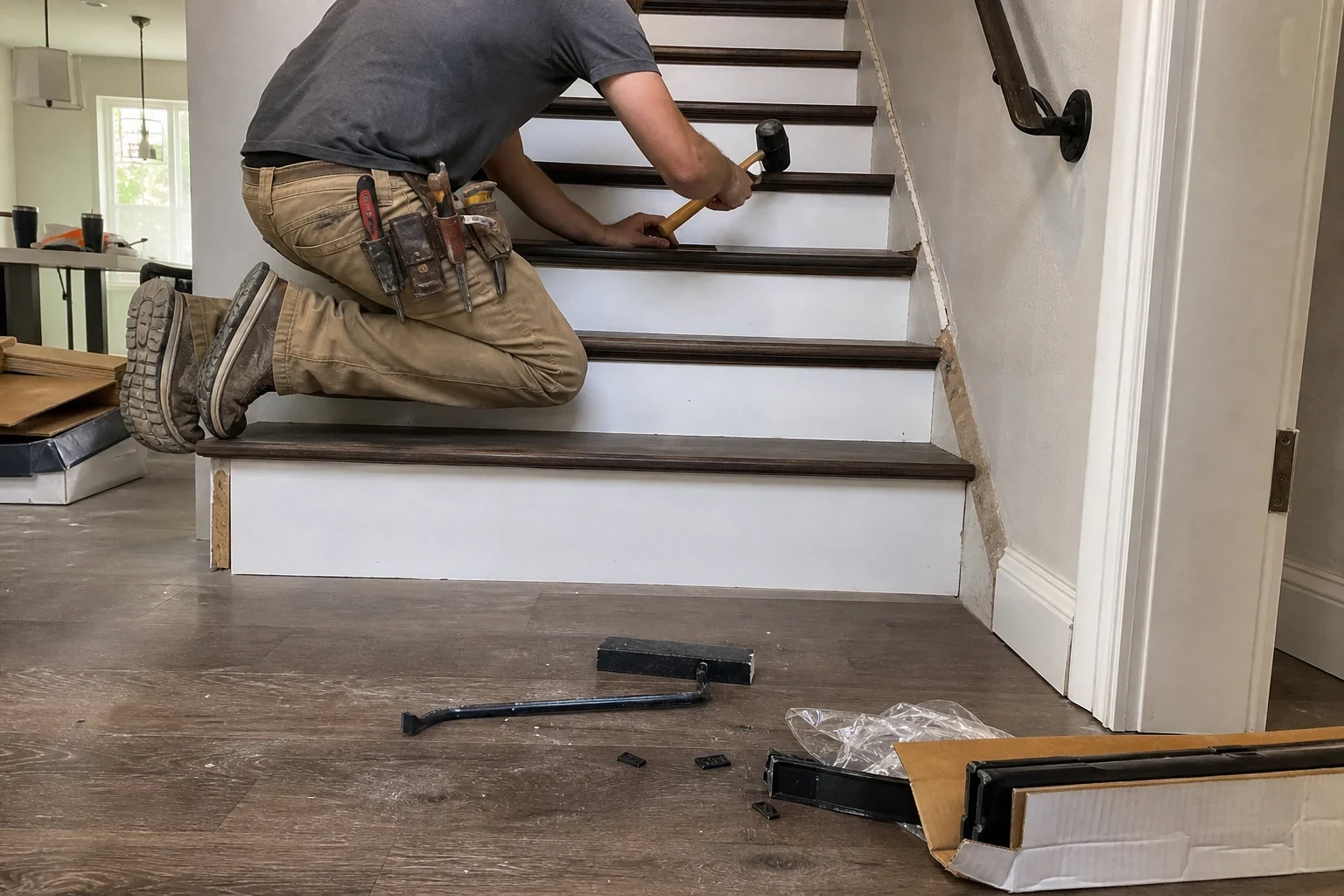
We put new flooring on stairs in hardwood, luxury vinyl, laminate and carpet. Every tread is measured and cut on its own, because older stairs are rarely even. You get steps that feel solid underfoot and match the floor at the top and bottom.
Why Stairs Get Their Own Page
A staircase is the hardest part of a flooring job. Each step is a small floor with an edge that takes a beating, and one loose nosing is a trip hazard. You can't run planks across it in long rows. Every tread and riser is its own cut.
In older houses the stairs have usually been covered more than once. We often pull carpet and find staples, tack strip, old glue, or painted pine treads with chipped edges. Sometimes a past repair left one step taller than the rest. We find that out early and fix what's under the floor before anything new goes on.
Stairs often get redone along with the rest of the house. If you're putting hardwood flooring or luxury vinyl plank downstairs, doing the stairs at the same time keeps the colors and edges matched.
What the Work Includes
- Tear-off down to the structure
- We remove the old carpet, pad, tack strip and staples. Old vinyl or glued treads come off too, so we can see the wood underneath.
- Fixing squeaks and loose treads
- A squeak usually means a tread has worked loose from the stringer. We screw and glue it tight before covering it, so the new floor doesn't creak on day one.
- Tread and riser fitting
- Each step is measured on its own and the material is scribed to the walls. That matters on older stairs, where one side of a tread can be wider than the other.
- Nosing that holds
- The front edge takes the most wear. We use a solid nosing piece or a matching stair-nose trim, fastened so it won't roll or lift when someone steps hard on it.
- Landings and transitions
- We tie the top step and any landing into the floor beside it so the change from stairs to hallway sits flush and looks planned.
Signs Your Stairs Are Due
Carpet worn bald on the edges
Stair carpet wears at the nose first. Once you can see backing or the pad crunches, it's slipping under your feet.
A step that moves or creaks
If a tread shifts when you step on it, the fasteners have let go. It gets worse with time and should be fixed before any new flooring goes on.
Steps that don't match
New floors downstairs and dated stairs make the whole house look half done. Patched or mismatched treads from a past repair stand out the same way.
Loose or cracked nosing
A cracked or lifting front edge can catch a heel. This is the most important one to fix.
One step feels off
If people trip on the same step, its height may be different from the others. Older stairs often have this after layers of flooring were added over the years.
How a Stair Job Goes
- 1
Talk it over by phone
You tell us how many steps, what's on them now and what you're thinking about. We'll talk through which materials work well on stairs and which don't.
- 2
Measure every step
We come out and measure each tread and riser, check for loose steps and look at the edges where the stairs meet walls and railings. Then you get your price.
- 3
Strip and repair
On install day we take off the old covering and show you what's underneath. Loose treads get tightened and uneven spots get leveled before we go further.
- 4
Install from the top down
We work from the top step down so we never stand on fresh work. Each piece is cut, fit and fastened, with adhesive on hard surfaces so nothing flexes.
- 5
Clean up and walk it with you
We haul off the old material and vacuum the dust. Then we walk the stairs with you, step by step.
What Moves the Price
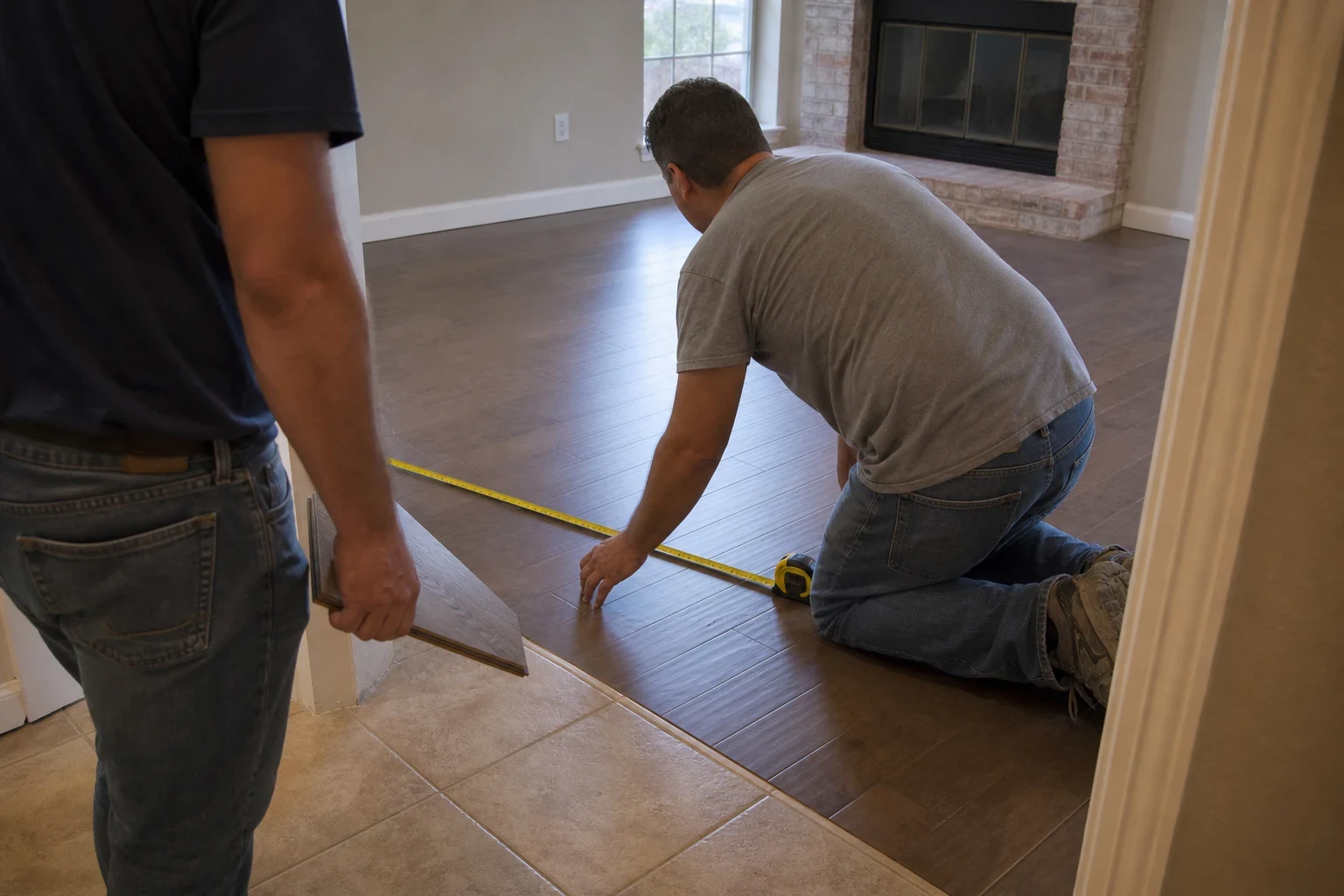
Stairs are priced by the step, not by the square foot. That's because the labor is in the cutting and fitting. A short straight run costs far less than a curved stair with a landing. We give you the price after we've measured and seen the condition of the steps.
- Number and shape of steps
- Straight steps go fastest. Winders, pie-shaped turns and bullnose bottom steps take more cutting and time.
- Open or closed sides
- An open side with balusters means returns on every tread end and careful cuts around each spindle.
- Material choice
- Solid hardwood treads, vinyl with matching nosing, laminate and carpet each have different material and labor costs.
- What's under the old floor
- Clean treads are simple. Heavy glue, loose steps or damaged wood from past repairs add prep work before install.
Stair Flooring Questions
Something not covered here? (346) 545-5749
Can luxury vinyl plank go on stairs?
Yes. We glue it to each tread and finish the edge with a matching stair nose made for that product. It's a good choice if you want the stairs to match vinyl floors downstairs. We don't float it on stairs, because a floating floor will move on a step.
Will you match the stairs to my existing floor?
We'll try to get as close as we can. With hardwood we look at species, width and color. Older floors have aged, so an exact match isn't always possible, and we'll tell you that before we start rather than after.
Can we still use the stairs during the job?
Mostly no while we're on them. Most of the day the stairs are a work zone, and glued treads need time to set. If your bedrooms are upstairs, plan for that and we'll talk about timing when you call.
Do you fix squeaks or just cover them?
We fix them. Once the old covering is off, we can reach the treads and fasten them back to the stringers. Covering a squeak only hides it for a while.
Is carpet still a good idea on stairs?
For a lot of families it is. Carpet is quieter and softer if someone slips, and it's easy on kids and older folks. We install it with new pad and tack strip, wrapped tight around each nose. Our carpet installation page has more on that.
Ready to Fix Those Stairs
Tell us how many steps you have and what's on them now. We'll come measure, check every tread and give you a straight price.